
A 5-minute read summarizing the importance of the Great British pub.
The Glue Holding Communities Together
For generations, the British pub has occupied a unique position within national life. It never has been simply a place to eat or drink. At its best, the pub is a civic institution, a cultural landmark, a meeting point and, increasingly, one of the last truly inclusive social spaces remaining within modern society.
The loneliness pandemic
In an age defined by increasing social fragmentation, loneliness, digital isolation and declining community interaction, the value of pubs extends far beyond economics. They are places where people from different backgrounds, generations and perspectives come together naturally. They foster conversation, friendship, local identity and belonging in a way few other institutions still can.
Yet despite this immense social contribution, pubs continue to face extraordinary pressure from rising costs, taxation, regulation, labour shortages, energy prices and changing consumer habits. Currently, we see around two pubs per day disappear from our cities, towns and villages. These closures are too often discussed purely in commercial terms, but the reality runs far deeper. When a pub closes, the community it serves loses part of its social infrastructure.
Recent research from Punch Pubs & Co in partnership with Northumbria University* provides perhaps the clearest evidence yet of the enormous social and economic contribution pubs make to Britain. The report, Evaluating the Economic and Social Impact of Pubs, quantifies what many within hospitality and local communities have understood instinctively for years.
The research concluded that the average pub contributes up to £1.3 million in economic and social value to its local community annually. Across Punch’s estate, pubs generate an estimated £1.7 billion in economic and social value every year. The study also highlighted how pubs support local suppliers, create employment, generate charitable contributions and stimulate wider economic activity.
However, perhaps the most important findings were not purely financial. The report identified pubs as critical centres of community engagement, social interaction and wellbeing. It demonstrated how pubs actively combat loneliness, provide safe and inclusive spaces, strengthen local identity and create environments where social bonds are formed naturally.
And this matters because Britain is experiencing what many social commentators now describe as a ‘crisis of disconnection’. Traditional community structures have weakened over recent decades. Churches, working men’s clubs, community centres and many other civic spaces have seen declining participation or closure altogether. Simultaneously, modern life has become increasingly individualised and digitally driven.
The result is a society that is more connected technologically than we ever have been, yet more disconnected and isolated socially than ever before.
Pubs help bridge that gap!
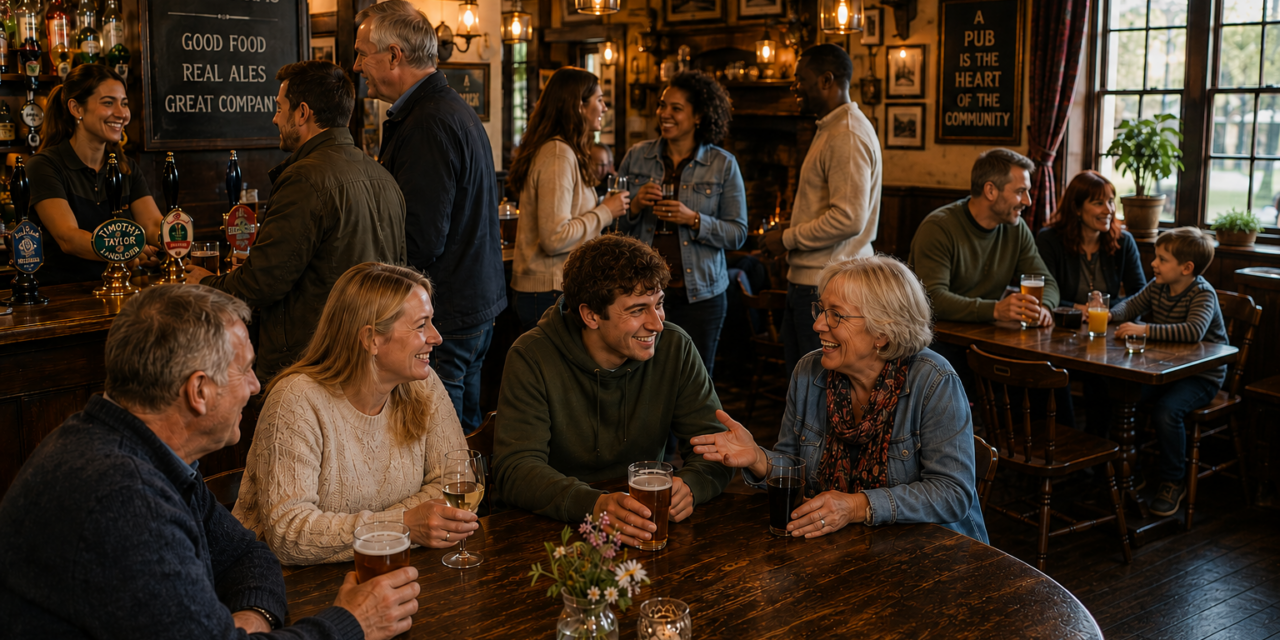
They remain one of the few places where human interaction occurs organically and without agenda. A pub does not require membership, social status or exclusivity. It welcomes tradespeople, office workers, pensioners, students, families and visitors alike. It creates a neutral environment where people can interact on equal terms.
This ‘social mixing’ is enormously important because healthy communities are not built purely through policy or public spending. They are built through relationships, familiarity and trust between individuals. They are built through repeated social interaction and shared local experiences. Pubs facilitate precisely that! And the Punch Pubs/Northumbria University report quantifies exactly this.
Whether it is a quiz night, a grassroots football sponsorship, a charity fundraiser, a wake, a birthday celebration or simply regular conversation at the bar, pubs create what sociologists often refer to as “social capital” — the invisible web of relationships and trust that strengthens communities.
The Northumbria University research reinforced this point through the creation of a Community Engagement Index, demonstrating a direct relationship between strong local engagement and both social impact and commercial resilience.
In simple terms, pubs that are deeply embedded within their communities do not merely survive — they become indispensable.
This should be a major consideration for policymakers.
Too often, discussions surrounding hospitality focus exclusively on taxation receipts, licensing or employment figures. While those areas are important, they fail to recognise the broader societal role pubs perform.
A pub is not merely another retail outlet.
It is often the only remaining communal space within towns, villages and neighbourhoods. In many communities, particularly rural areas, the local pub acts as an informal support network, helping reduce social isolation and creating opportunities for people to engage with others face-to-face.
This is especially significant given growing concerns around mental health and loneliness. With studies repeatedly showing that social isolation carries serious consequences for both physical and mental wellbeing. The pub sector quietly alleviates many of these pressures every day, often without recognition.
The economic importance of pubs is equally substantial. The Punch and Northumbria University report highlighted how pubs create local employment opportunities, particularly for young people entering the workforce for the first time. They support nearby suppliers, entertainers, tradespeople and local producers, ensuring money circulates within regional economies.
For every pound spent within hospitality, additional economic activity is generated throughout surrounding supply chains and communities. Pubs are economic anchors as much as social ones.
Yet despite this, the sector often feels overlooked within national economic strategy.
Hospitality remains one of Britain’s largest employers and one of the country’s most socially valuable industries, but operators continue to face mounting financial pressure. Rising National Insurance contributions, increases in the National Minimum Wage, escalating utility costs, inflationary pressures and regulatory burdens are all placing enormous strain on businesses already operating on tight margins.
The danger is not simply that businesses close. The danger is that communities lose vital spaces that hold people together!
The closure of a pub removes far more than a commercial premises. It removes a venue for social interaction, charity fundraising, local celebrations, sporting communities, family gatherings and everyday conversation. It weakens local identity and reduces opportunities for human connection.
That is why the findings of the Punch Pubs and Northumbria University report should act as a catalyst for more informed policymaking. If government genuinely wishes to strengthen communities, improve social cohesion, support local economies and tackle loneliness, then pubs must be recognised as strategic community assets rather than simply hospitality businesses.
Protecting pubs is not nostalgia. It is social investment.
Britain’s pubs continue to prove their value every single day — economically, culturally and socially. They remain among the few institutions capable of bringing people together across age, class and background in an increasingly divided and disconnected world.
At their very best, pubs do not simply serve communities.
They help create them.
You can read the full report ‘Evaluating the Economic and Social Impact of Pubs’ at www.punchpubs.com /socialvalue/